
Electromagnetic Field Analysis and Modeling
Lunar Vertex Mission
I am a co-investigator on the Lunar Vertex mission, which will explore the lunar swirl known as Reiner Gamma. I am interested in constraining the subsurface geometry of the magnetic anomaly associated with the Reiner Gamma swirl to understand lunar magnetization processes and how the near-surface magnetic topology and ambipolar electric fields relate to the development of the swirl pattern and photometric and spectroscopic properties of the regolith.
I was previously the instrument scientist of the two magnetometer instrument suites on Lunar Vertex, doing sensor characterization and calibration for the assembly and delivery of the Vector Magnetometer suites (VMx) and implementing the novel gradiometry algorithm to be used to analyze noise sources during the mission.
I developed an empirical miniature magnetosphere model as part of my master's thesis to investigate variable solar wind conditions that may occur over the course of the mission and compression effects that may be observed by the VMx suites on the lander and rover.
GravMagSphere and GravMagPy
Equivalent Source Modeling
I am actively developing a Fortran program for gravity and magnetic field equivalent source modeling.
GravMagSphere is a derivative of Dr. Dhananjay Ravat's moonsphere model, a potential field forward modeling program that takes a prescribed body geometry and physical properties as input and computes the resulting gravity or magnetic field on an observation grid. I rewrote moonsphere into modern, modular Fortran with allocatable arrays, simpler lon-lat polygon handling, and updated field kernels. GravMagSphere provides a direct solver where the field is computed in physical space by numerically summing contributions from source elements at each observation point, and a spectral least-squares spherical-harmonic solver where the source response is represented with spherical-harmonic coefficients and the field is reconstructed from that harmonic expansion. I am currently working on a solution optimization routine in
GravMagSphere that will allow for coupled gravity and magnetic field inversions from orbital data, to solve for subsurface geometry of geologic features such as the magnetic anomaly associated with Reiner Gamma.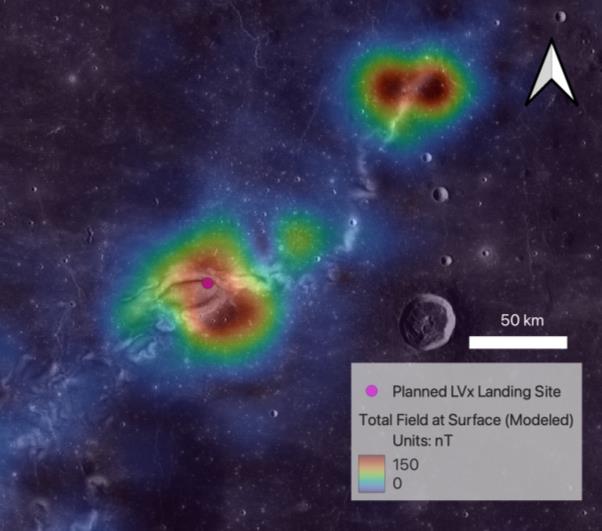
Potential Field Analysis and Visualization
As part of
GravMagSphere, I have been developing a Python toolkit for gravity and magnetic field visualization and analysis at planetary surfaces, which integrates with other equivalent source solvers to model subsurface sources such as the magnetic anomaly associated with Golitsyn crater (seen below).
Moonsphere
Lunar Magnetics
As an undergradauate research assistant working with Dr. Ravat's
moonsphere model, using Clementine and Lunar Prospector (LP) data, I produced high resolution maps of the lunar swirl named Reiner Gamma (seen below). I created iterative solutions for the crustal magnetic anomaly associated with this lunar swirl to constrain the subsurface geometry of the source, in pursuit of understanding the formation of the anomaly. We also created a highly refined dataset from the LP magnetometer to apply a new inversion technique and produce a high-resolution global map of magnetic anomalies on the lunar surface.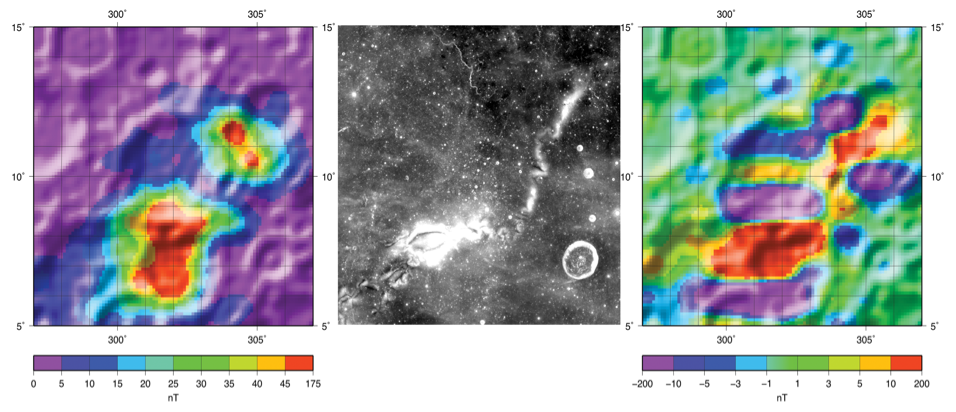
Martian Magnetics
During my time in Dr. Ravat's lab, I also processed MAVEN magnetometer data to help produce a global map of the Martian magnetosphere. I combined and refined monthly downlinks of MAVEN data, and mentored two students who joined the lab when I was a senior.